Consistent with statutes of the Forests and Fish Law, Washington’s private forest
landowners rely on peer-reviewed science to help create and evaluate sustainable forest
practices.
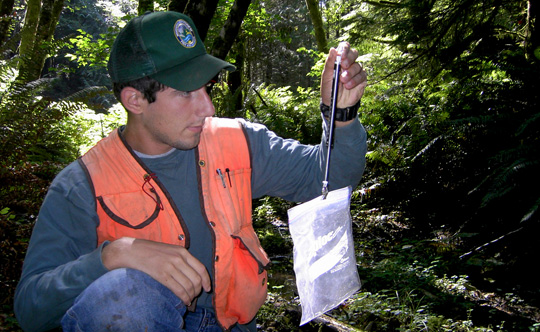
Measuring bag weight after measuring amphibian in the bag during a non-fish-bearing streams study.
Adaptive Management: Focus on Four Key Goals
More than 140 individuals, including scientists, policy makers, and regulators worked together
for 18 months to develop the scientifically-based changes to forest practices rules found in the
Forests & Fish Law to meet four key goals established by the Forest Practices Board:
Provide compliance with the Endangered Species Act for aquatic and riparian-dependent species.
Restore and maintain riparian habitat to support a harvestable supply of fish.
Meet the requirements of the Clean Water Act for water quality.
Keep the timber industry economically viable in the state of Washington.
Click here
to see more information about the private timber industry’s contribution to the state economy.
The rules are monitored on the ground to ensure the objectives of restoring salmon habitat
and protecting water quality are being met. If they are not, the rules will be changed
through peer-reviewed scientific determination and
Adaptive Management. This allows for rule changes if science shows it to be necessary.
Forest Practices Habitat Conservation Plan (FPHCP)
On June 5, 2006, the federal government approved a 50-year Habitat Conservation Plan endorsing
the State Forest Practices Program for protecting fish and water quality. The FPHCP was developed
with recommendations from the multi-stakeholder Forests & Fish Report, adopted into rule July 2001.
Forest practices result in improved aquatic and riparian habitat as well as improved water quality that
better meet the ecological needs of fish and water.
The FPHCP created and implemented an effective Adaptive Management Plan for three reasons:
To ensure change will occur as needed
To provide stability in the process of change and
To ensure quality controls are applied
Progress is measured through resource objectives
Progress toward reaching the four goals is measured through a set
of resource objectives established by scientists for key aquatic
conditions and processes. These objectives are designed to meet the
conditions that salmon need to thrive during various phases of their
life cycle.
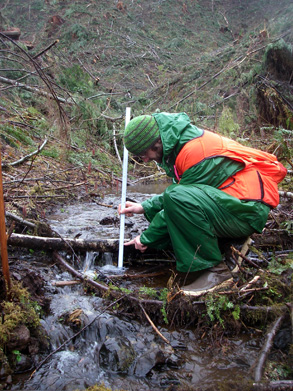
Scientific research is being conducted to test the effectiveness of
forest practices to determine whether resource objectives are
providing:
Cool water by maintaining shade
Large woody debris for in-stream habitat
Clean water by protecting unstable slopes and improving roads to prevent excessive sediment
from entering into streams
A natural hydrologic regime by disconnecting road drainage from streams
Preventing application to surface water and retaining natural vegetation buffers along streams
to prevent silvicultural herbicides from entering the streams
Fish habitat for all life stages at any time of the year by correctly classifying streams and removing barriers to fish passage
Adaptive Management and Program Refinements
Adaptive Management is a method for examining alternative strategies and is the mechanism for
refining protection measures in an ongoing cycle of learning and improving over-time. The process
complements the forest practices rules in two ways: 1) addressing near-term uncertainties, and 2)
ensuring compliance with the Endangered Species Act over the long-term.
The Forest Practices Board formally established the adaptive management process which is managed
and implemented by four entities:
Cooperative Monitoring Evaluation and Research Committee (CMER). Provides an integrated strategy
for considering, prioritizing and conducting research and monitoring to inform policy representative
and the FPB.
Adaptive Management Program Administrator (AMPA). Supports CMER, assures objectivity of the
science work and manages the business affairs of the committee.
Forests and Fish Policy Group (FFPG). A collaborative forum of policy level people who informally
advise CMER on routine matters and provide the FPB with consensus rule recommendations flowing from
the scientific results provided by CMER.
Forest Practices Board (FPB). Appointed by the Governor, is charged by the Forest Practices Act
with writing forest practices rules for the State of Washington.
The Washington State Legislature established the Forests & Fish Account in March 2006, funded by a surcharge on the Business and Occupation tax on forestry to provide adequate funding for adaptive management and monitoring of the implementation of the Forest Practices Habitat Conservation Plan.